Cleanroom HVAC Systems: Airflow, HEPA Integrity, and Recovery Rate Qualifications
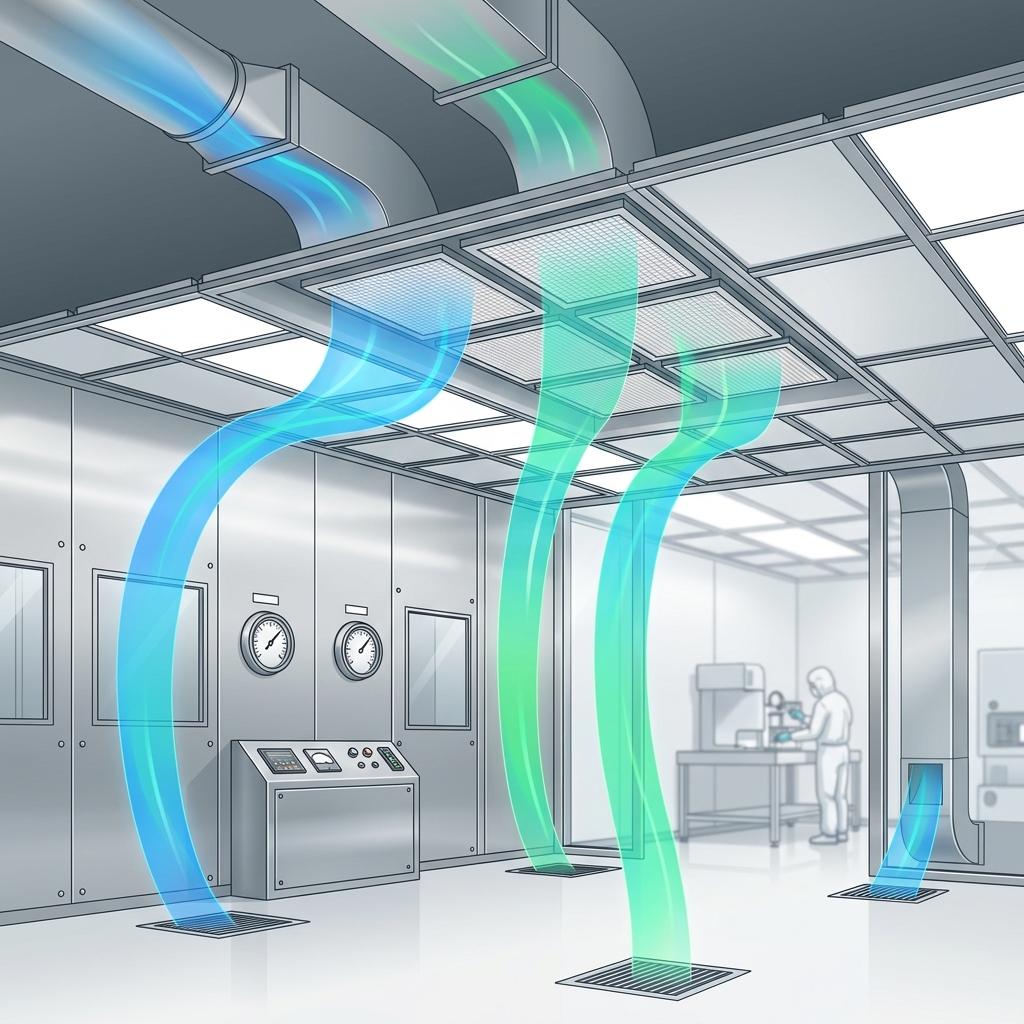
Heating, Ventilation, and Air Conditioning (HVAC) systems are the core engineering control in pharmaceutical cleanrooms. They maintain temperature, humidity, pressure differentials, and remove airborne particulate contaminants. In this technical article, we explore cleanroom HVAC qualifications, detailing HEPA filter integrity leak tests, airflow smoke studies, and recovery rate metrics.
Classification of Clean Zones
Under ISO 14644 and GMP Annex 1 guidelines, cleanrooms are classified into Grade A, B, C, and D zones based on active particle counts. Grade A represents the highest sterility level (sterile filling zones), requiring laminar airflow and minimal particle limits. Grade B acts as the background environment for Grade A. Grade C and D are used for less critical formulation, packaging, and laboratory support areas.
HEPA Filter Integrity Testing (DOP/PAO Method)
HEPA filters capture at least 99.97% of particles down to 0.3 microns. To ensure they remain leak-free, they must undergo periodic testing using Dispersed Oil Particulate (DOP) or Polyalphaolefin (PAO) aerosols. The aerosol is injected upstream of the filter, and a photometer probe scans the downstream face and seals. Any penetration exceeding 0.01% of the upstream concentration indicates a leak that must be repaired or replaced immediately.
Pressure Cascades and Air Changes Per Hour
To prevent contaminated air from entering clean zones, HVAC systems must maintain positive pressure cascades. Air must flow from cleaner zones to adjacent less clean areas, typically requiring a minimum differential of 10 to 15 Pascals. Furthermore, Air Changes Per Hour (ACPH) must be qualified. While Grade D rooms require 15 to 20 air changes per hour, Grade B zones typically require 40 to 60 air changes to ensure continuous air purification.
Airflow Visualization (Smoke Studies) and Recovery Tests
Regulatory inspectors expect to see video evidence of airflow visualization under rest and operating conditions. Smoke studies prove that the laminar airflow in Grade A areas remains smooth, unidirectional, and sweep contaminants away from sterile containers without creating dead zones. Finally, recovery rate tests verify that the cleanroom can recover its target cleanliness class within 15 to 20 minutes following a temporary contamination event.
Subscribe to our monthly GMP newsletter
Receive Hyderabad pharmaceutical regulatory updates directly to your inbox.
Join Newsletter List